









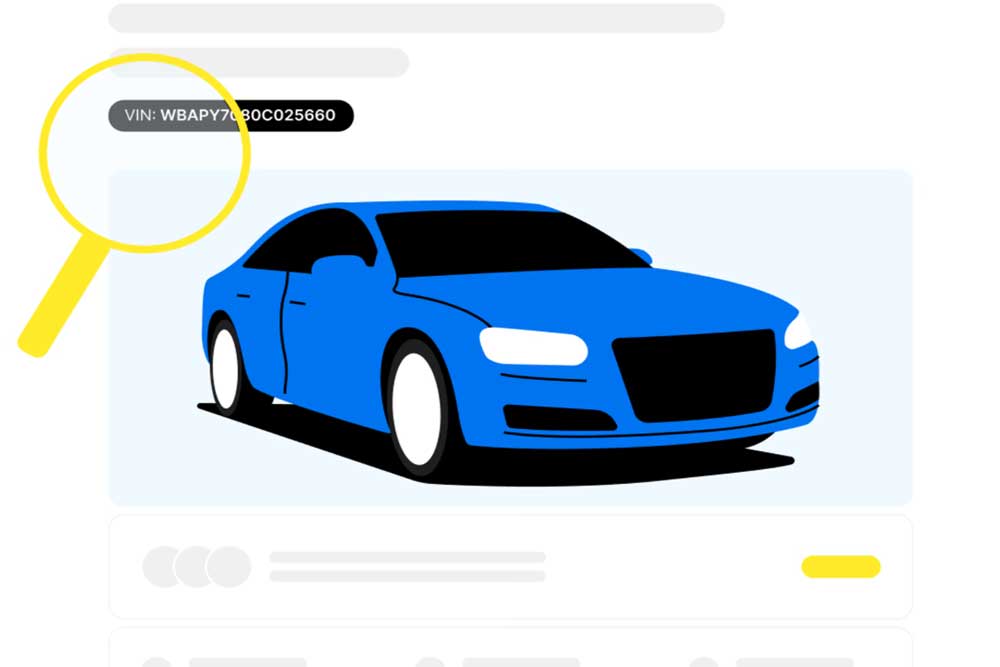
Every car built since 1981 has a VIN — a 17-character code stamped into the chassis, etched onto the dashboard, and printed on every official document the car has ever touched. Most people ignore it entirely.
That’s a mistake.
Those 17 characters aren’t random. Each position encodes specific information about where the car was made, who made it, what engine it has, and when it rolled off the assembly line. If you know how to read it, the VIN is a bit like a car’s birth certificate — full of facts, but quiet about everything that happened afterward.
And that’s where the limits start. The VIN tells you a lot about what the car *is*. It tells you almost nothing about what the car has *been through*.
Let’s break it down.
## Positions 1-3: World Manufacturer Identifier (WMI)
The first three characters identify the manufacturer and the country of assembly.
Position 1 is the country or region: W = Germany, J = Japan, 1/4/5 = United States, S = United Kingdom, Z = Italy, K = South Korea, L = China.
Positions 2-3 narrow it to the manufacturer: WBA = BMW, WDB = Mercedes-Benz, WVW = Volkswagen, VF1 = Renault, ZFA = Fiat.
And here’s something that surprises a lot of buyers: a “German” car isn’t always made in Germany. A BMW X3 built in South Carolina starts with 5UX, not WBA. A Volkswagen Tiguan built in Mexico starts with 3VV. The VIN reveals the actual assembly location, not just the brand’s home country.
## Positions 4-8: Vehicle Descriptor Section (VDS)
These five characters encode the vehicle’s attributes — model, body style, engine type, and transmission.
This is where manufacturers diverge. There’s no universal standard for positions 4-8. BMW uses them differently than Toyota, which uses them differently than Volkswagen.
Manual VIN decoding is hard because you’d need manufacturer-specific codebooks. Automated VIN decoders handle this by maintaining databases for every manufacturer’s encoding scheme.
## Position 9: Check Digit
Position 9 is a calculated character that validates the entire VIN through an algorithm. Change any single character elsewhere, and the check digit won’t match. This makes fabricating fake VINs mathematically difficult.
European manufacturers weren’t required to use the check digit until recently. Many European VINs from the 1990s use a random character here.
## Position 10: Model Year
Position 10 encodes the model year using a rotating system: A = 2010 (or 1980), B = 2011, and so on through the alphabet, then 1-9, repeating every 30 years.
A car built in November 2024 might carry a 2025 model year code. And some European manufacturers didn’t strictly follow this convention before 2010, so treat position 10 as a guide, not gospel. Especially on older German cars — it can be wrong.
## Position 11: Assembly Plant
Each manufacturer assigns their own plant codes. For BMW: A = Munich, F = Graz (Austria), K = Leipzig, E = Dingolfing. Useful for enthusiasts who care about which factory built their car.
## Positions 12-17: Sequential Production Number
The last six characters are the car’s serial number within its production sequence. Car #000001 was the first off the line. Nothing mysterious here.
## What the VIN Actually Tells You
Reading the VIN gives you verified facts about the vehicle’s identity: where it was made, who made it, what model and engine it has, when it was built, and its unique serial number.
This information is baked in at the factory and can’t be changed without physically altering the VIN plate — which is illegal everywhere and leaves detectable evidence.
## What the VIN Doesn’t Tell You
Here’s the thing most people miss.
The VIN identifies the car. It doesn’t describe the car’s life.
A VIN won’t tell you how many kilometers it’s driven, whether it’s been in an accident, how many owners it’s had, whether it’s been stolen, what condition it’s in, whether recalls have been addressed, or whether the mileage has been tampered with.
None of that is in the 17 characters. Zero.
## Decoding Ends. Checking Begins.
Decoding the VIN is just the start. The real value is the history behind it.
When you check your VIN through a history service, that 17-character code becomes a key that unlocks data from national vehicle registries, inspection databases, and law enforcement systems across Europe. Suddenly you can see mileage recorded at every inspection, accident damage reports, stolen vehicle alerts across the Schengen zone, outstanding recalls, and registration history across multiple countries.
That’s the information that actually protects you when buying a used car. The VIN tells you *what* the car is. The history check tells you *what happened to it*.
Carlytics, for example, cross-references VIN data against Czech, Finnish, Norwegian, German, Dutch, and UK registries — plus NHTSA data for US-origin vehicles. The VIN decoder breaks down all 17 characters into plain language, and the history report shows everything those registries have recorded. It’s one of the best VIN check services for European buyers who want both the decode and the full history in one place.
## Watch Out for VIN Cloning
VIN cloning is when a thief copies the VIN from a legitimate car and puts it on a stolen vehicle. The stolen car now has a “clean” VIN that passes basic checks.
Physical VIN verification matters here. The VIN is stamped in multiple locations — dashboard, driver’s door jamb, engine block, and sometimes the trunk. If they don’t all match, or if any look tampered with, that’s a serious red flag.
A history check can catch cloning too — if the same VIN appears registered in two countries simultaneously, or if recorded mileage shows impossible patterns, something’s wrong.
## The Bottom Line
Your VIN is more than a serial number. It’s an identity card — and when combined with the right databases, a complete biography of your car.
Learn to read it. But more importantly, learn to check what’s behind it. Those 17 characters are the start of the story, not the end.